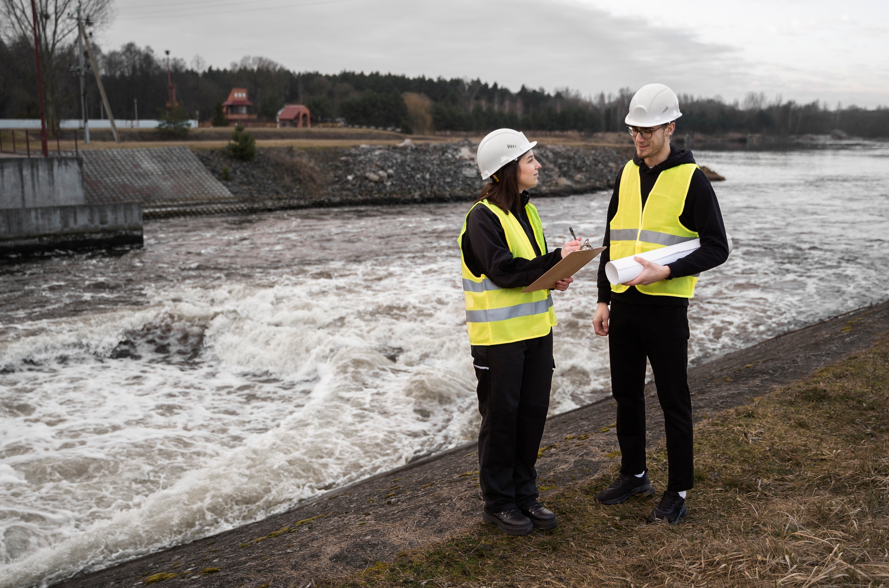
Post-flood properties face hidden risks: reactivated underground toxins and trapped indoor moisture causing mould. Left unchecked, these lead to severe health hazards and regulatory delays. An integrated, phased environmental assessment ensures complete safety, compliance, and occupant health.
Key Takeaways
- Subsurface Contamination: Floods mobilise legacy soil contaminants and elevate groundwater, invalidating prior low-risk environmental site clearances
- Indoor Air Quality: Trapped structural moisture fosters hidden mould growth and poor indoor air quality despite surfaces appearing dry
- Integrated Framework: Managing flood risks requires a unified strategy spanning preliminary desktop reviews, soil testing, structural drying, and air validation
After a flood or waterlogging, property risk is not just what is visibly damaged. It becomes a two-layer problem that spans to what has happened beneath the ground and what is now trapped in the nooks and crannies inside the building.
This blog will explain how you can manage environmental risks arising from flood-impacted properties, covering risks ranging from subsurface contamination to indoor air contamination. This is because the risk from both is one connected continuum, not two separate problems.
The Two-Layer Risk Floods Leave Behind
Subsurface Risk: Floodwater can mobilise or redistribute existing soil/groundwater contamination. For example, if the property was built on a former industrial, agricultural, or service station site.
Indoor Air Risk: In this case, moisture ingress from the floodwater drives mould growth and VOC off-gassing. This happens in both occupied and soon-to-be-occupied buildings.
Both of them cause the same site risk profile that you, as a developer, owner, or resident, have to manage to keep the property legally and environmentally safe.
Subsurface Contamination – What Floodwater Moves, What It Leaves Behind
Rising groundwater tables and sediment deposition can reactivate contamination that a pre-flood assessment showed/rated as low-risk. This is why a site or a property with an old contamination clearance may still need retesting after a flood event.
Especially in sites where fill material or historical land use is involved. This is where you will need a land condition assessment to re-establish the site risk status post-flood.
| Flood Mechanism | Subsurface Risk Introduced | Recommended Assessment Response |
| Rising groundwater table | Mobilises historical contaminants (hydrocarbons, heavy metals) toward the surface | Reassessment of previously validated sites via an updated site assessment plan |
| Sediment deposition from floodwater | Introduces new surface contamination; sewage, agricultural runoff, industrial residue | Surface soil sampling before any earthworks begin |
| Erosion and fill disturbance | Exposes or redistributes legacy fill material such as ash or demolition waste | Site history review followed by intrusive investigation |
| Saturated subsurface soils | Raises the risk of vapour intrusion into slab-on-ground structures | Soil vapour survey ahead of re-occupation |
Table 1: Contaminant Mobilisation Pathways
| FACT Floodwater doesn’t just add new contamination; it can reactivate contamination already assessed as low-risk years earlier. A site cleared a decade ago may need retesting once flooding disturbs groundwater levels or redistributes buried fill material across the property boundary. |
Real World Scenario
A developer buying flood-affected land with a decade-old contamination clearance commissioned a fresh land condition review before subdivision began. It found elevated hydrocarbon levels the original report had missed, avoiding a costly compliance issue after construction had already started.
From Ground to Indoor Air – How Subsurface Risk Becomes an Occupant Health Issue
Saturated subsurface soils and slab moisture can drive vapour intrusion and capillary rise. This feeds damp subfloors and wall cavities, making them damp, creating a suitable environment for mould growth.
This leads to mould proliferation that degrades the indoor air quality for occupants. For this reason, professional mould assessments are essential, where licensed environmental assessment specialists check and confirm whether ground moisture has resulted in occupant-facing air quality issues.
| CAUTION Visual dryness isn’t proof of safety. Surfaces can look completely dry within just a few days while moisture stays trapped inside wall cavities or subfloors for weeks afterwards, quietly creating the damp, dark conditions mould needs to establish itself and spread. |
A Phased Environmental Risk Framework for Flood-Impacted Redevelopment
Here are the typical land condition reassessment triggers that signal a property owner to act immediately.
- A prior contaminated land assessment predates the flood event
- Visible sediment, oil sheen, or odour on the site surface after floodwater recedes
- Subfloor or wall cavities remain damp more than 72 hours after water recedes
- The site sits on or near a historical contaminated land register
- A change of land use is planned; for example, industrial to residential
The following table shows the framework for site assessment.
| Phase | Focus Area | Typical Trigger | Standard/ Reference |
| 1. Preliminary Desktop Review | Site history, prior land use, flood extent mapping | Any redevelopment on flood-affected land | ASC NEPM 1999 |
| 2. Land Condition Assessment | Soil and groundwater sampling, vapour risk screening | Confirmed or suspected legacy contamination | ASC NEPM, state EPA guidelines |
| 3. Building Drying Validation | Moisture content in structural elements | Post-flood re-occupation planning | AS-IICRC S500:2025 |
| 4. Mould Assessments & IAQ Testing | Airborne spore counts, surface sampling, VOCs | Visible mould, odour, or occupant health complaints | AS-IICRC S500:2025, AIRAH DA19/Safe Work Australia IAQ guidance |
| 5. Combined Sign-Off | Cross-verification of subsurface and indoor findings | Before construction, sale, or occupation | Project-specific validation criteria |
Table 2: Phased Assessment Matrix
Real World Scenario
After a commercial tenancy flooded, building managers held off reoccupying the space until independent air testing confirmed spore counts had returned to safe background levels, protecting occupant health and giving the insurer clear, verified evidence to support the claim.
See also: How to Ensure You Maintain Good Ratings on Yelp
Conclusion
Flood-impacted redevelopment needs one integrated risk view; not two disconnected assessments run separately. This is because post-flood dampness and lack of ventilation can cause both surface and indoor air contamination through mould, fungus, and bacterial growth.
Did Your Property Face Floods or Waterlogging Recently?
Do not wait till the problems arise. Look for licensed environmental consultants who offer site assessment and remediation services for both subsurface and air quality.